
Running a creator agency means juggling invoices from multiple revenue streams simultaneously. Whether you're billing brands for sponsored content, processing platform payouts, or managing affiliate commissions, getting clients and partners to pay this invoice on time directly impacts your ability to compensate models and keep operations running smoothly. For agencies managing 15 to 20 models or more, invoice delays compound quickly, turning cash flow management into a daily challenge that can stall growth and damage relationships.
The Real Cost of Invoice Payment Delays
Payment delays create a cascading effect throughout your agency. When you can't pay this invoice from a brand partner within expected timeframes, you're left waiting to distribute earnings to your models. This delay affects trust, retention, and your ability to attract top talent.
How Late Payments Impact Agency Operations
Late invoice payments force agencies into reactive mode. Your team spends hours following up on outstanding payments instead of focusing on content strategy, audience growth, and model development. Cash flow uncertainty makes it impossible to forecast monthly expenses accurately or plan strategic investments in team expansion.
Consider the operational bottleneck: you've completed a brand partnership campaign, delivered content, and sent the invoice. The brand's payment terms specify Net 30, but payment doesn't arrive until day 45 or 60. Meanwhile, your models expect their share within your agreed timeframe, forcing you to bridge the gap from reserves or delay their payments, both problematic solutions.

| Payment Delay | Immediate Impact | Long-Term Consequence |
|---|---|---|
| 15-30 days | Strained model relationships | Increased churn rate |
| 30-60 days | Cash flow disruption | Inability to onboard new talent |
| 60+ days | Payroll concerns | Reputation damage |
Establishing Clear Payment Terms Before Work Begins
The foundation of efficient invoice management starts during the contract phase. Before your models create a single piece of content for a brand deal or partnership, payment terms must be explicit, documented, and agreed upon by all parties.
Defining Standard Payment Structures
Most professional relationships operate on standard payment terms like Net 30, Net 15, or Due on Receipt. According to common invoice payment term standards, Net 30 remains the business norm, but creator agencies often negotiate faster terms given the rapid content production cycles.
When negotiating brand partnerships, specify:
- Payment timeline from invoice submission (Net 15 is reasonable for creator work)
- Acceptable payment methods (wire transfer, ACH, platform payment)
- Late payment penalties (typically 1.5% monthly interest)
- Required documentation before invoice submission
- Dispute resolution process for contested invoices
Your onboarding documentation should mirror these expectations with your models. If you operate on Net 15 terms with brands, communicate realistic payout schedules to your roster that account for processing time. Transparency prevents mismatched expectations and the awkward conversations that follow.
Crafting Professional Invoices That Get Paid
An incomplete or confusing invoice gives clients an easy excuse to delay payment. Professional invoicing isn't just about looking polished; it's about removing every possible friction point between "sent" and "paid."
Essential Invoice Components for Creator Agencies
Every invoice you send should include specific information that makes payment straightforward. The legal requirements for invoices in the United States vary by state, but certain elements remain universal best practices.
Required information includes:
- Unique invoice number for tracking and reference
- Invoice date and payment due date prominently displayed
- Your agency's legal business name and contact information
- Client's billing information exactly as it appears in their system
- Detailed line items describing services rendered
- Payment terms restated from the contract
- Accepted payment methods with specific instructions
- Total amount due in clear, bold text
For creator agencies specifically, line items should reference the campaign name, content deliverables, platform metrics (if performance-based), and date ranges. Vague descriptions like "content creation services" invite questions and delays. Instead, write "Instagram Reels campaign (5 videos), February 1-15, 2026, per agreement dated January 10, 2026."
Timing Your Invoice Submission
When you send an invoice matters as much as what it contains. Don't wait until the end of a billing cycle if deliverables are complete earlier. The faster you invoice, the faster the payment clock starts.
Many agencies follow invoicing best practices by sending invoices immediately upon campaign completion or on a set schedule (1st and 15th of each month) for ongoing services. Consistency helps clients budget and process payments in their regular cycles.

Building a Systematic Follow-Up Process
Even with perfect invoices and clear terms, some clients will miss payment deadlines. A systematic follow-up process removes emotion from collections and maintains professional relationships while protecting your cash flow.
The Three-Touch Follow-Up Framework
Implement a standardized follow-up sequence that escalates professionally:
Touch 1 (Day of due date): Send a friendly reminder email referencing the invoice number, original due date, and payment instructions. Keep the tone helpful rather than accusatory; many payment delays result from internal processing issues rather than refusal to pay this invoice.
Touch 2 (5-7 days past due): Follow up with a more direct message that includes the invoice attached, total amount owed, and a specific request for payment timeline. Ask if there are any issues preventing payment and offer to resolve them.
Touch 3 (14-15 days past due): Send a formal notice that payment is significantly overdue, reference any late payment terms from your contract, and provide a final deadline before escalating further. This communication should come from agency leadership, not junior staff.
For agencies managing multiple brand partnerships and revenue streams, manual follow-up becomes unsustainable beyond 10-15 active clients. Automation tools can trigger these reminders while maintaining the personal touch through customized templates.
Leveraging Technology to Streamline Invoice Management
Manual invoicing through spreadsheets and email chains breaks down as your roster scales. When you're managing payments for 20+ models across dozens of brand partnerships, affiliate programs, and platform earnings, centralized systems become operational necessities.
Integration Between Invoicing and Agency Operations
The most efficient agencies run their invoicing as part of a broader operational system rather than a standalone process. When your invoicing connects directly to your client management, contract storage, and payout processing, you eliminate duplicate data entry and reduce errors.
For creator agencies specifically, this means your system should track:
- Active brand partnerships and their payment terms
- Content deliverables tied to specific invoice line items
- Model revenue shares calculated automatically
- Payment status across all revenue streams
- Outstanding amounts and aging reports
When a brand finally pays an overdue invoice, that payment should automatically trigger the corresponding model payout calculation without manual intervention. This integration ensures your team can pay this invoice to models promptly while maintaining accurate profit and loss tracking.
BIGROS handles this integration natively, connecting invoicing directly to your compliance records, contracts, and live P&L dashboards. Instead of switching between platforms to verify payment status, check contract terms, and calculate model shares, everything operates from one screen.
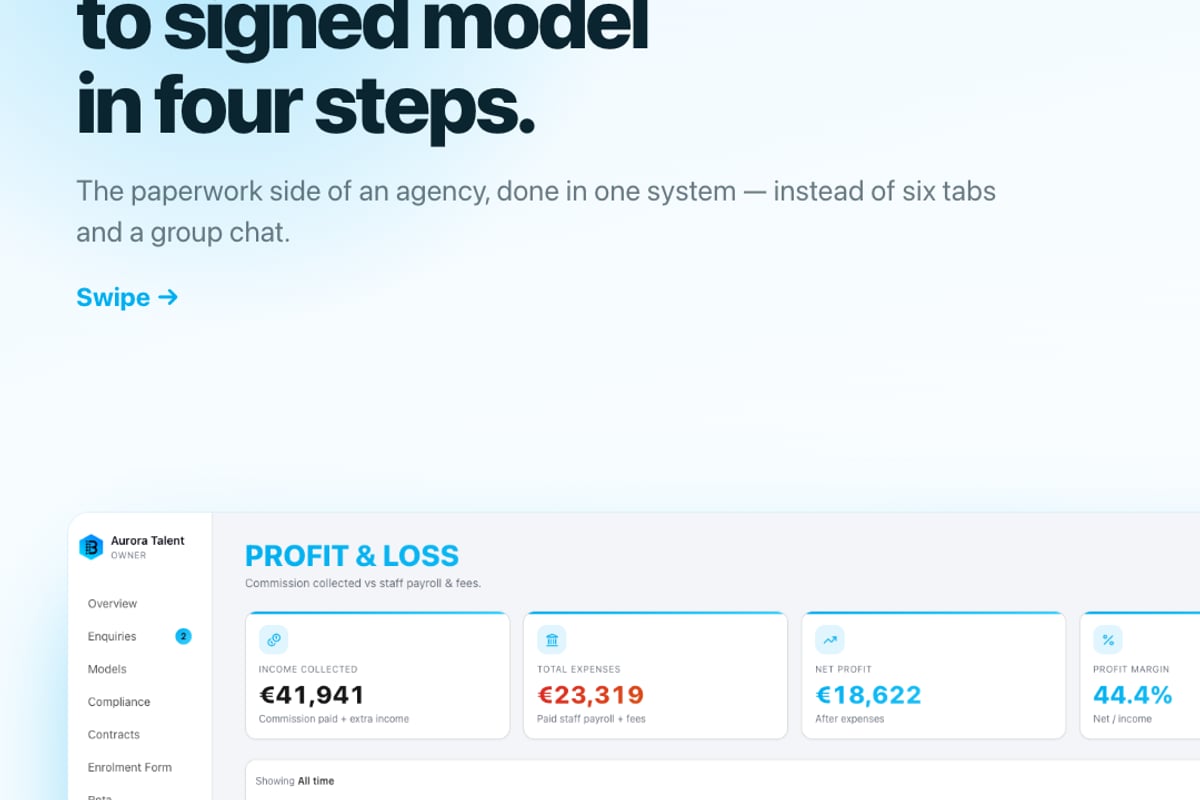
The platform's approach means when you generate an invoice for a brand partnership, it's already linked to the model's profile, their revenue share percentage from the contract, and your agency's commission structure. Payment tracking feeds directly into your financial dashboards, giving real-time visibility into accounts receivable and cash position.
Managing Multiple Revenue Streams and Invoice Types
Creator agencies rarely operate on a single revenue model. Your invoicing system must accommodate brand partnerships, platform revenue shares, affiliate commissions, subscription services, and custom arrangements simultaneously.
Categorizing Invoice Types for Better Tracking
Different revenue streams require different invoicing approaches and payment expectations. Understanding the legal and tax implications of sending invoices for various income types helps maintain compliance while optimizing cash flow.
| Revenue Type | Typical Payment Terms | Invoice Complexity | Follow-Up Frequency |
|---|---|---|---|
| Brand Partnerships | Net 15-30 | High (deliverables-based) | Weekly if overdue |
| Platform Revenue | Net 7-14 | Low (percentage-based) | Automated |
| Affiliate Commissions | Net 30-60 | Medium (performance-based) | Monthly |
| Management Fees | Net 15 | Low (fixed recurring) | Bi-weekly if overdue |
Brand partnership invoices typically involve the most complexity because payment hinges on deliverable approval, metrics verification, and often multi-level approval processes within the client organization. These invoices benefit from detailed backup documentation including content links, engagement metrics, and signed approval forms.
Platform revenue invoicing, by contrast, operates on a more predictable cycle. OnlyFans, Fansly, and similar platforms distribute earnings on set schedules. Your invoicing to models for your management fee should align with these platform payment dates to maintain positive cash flow.
Handling Disputed Invoices Professionally
Occasionally, clients will dispute an invoice amount or delay payment pending resolution. The legal timeframes for issuing invoices and responding to disputes vary, but professional handling preserves relationships while protecting your interests.
When a client disputes an invoice:
- Acknowledge the dispute within 24 hours and request specific details
- Review your contract and deliverables against their concerns
- Provide documentation supporting your invoice (content links, metrics, approvals)
- Propose solutions if legitimate issues exist (partial payment, revised deliverables)
- Escalate formally only after good-faith resolution attempts fail
Most disputes stem from miscommunication rather than bad faith. A client might expect different deliverables, have different metric interpretations, or face internal budget constraints. Addressing these professionally often leads to modified payment plans rather than complete non-payment.

Building Cash Flow Buffers for Payment Variability
Even with perfect invoicing practices, payment timing will vary. Successful agencies build financial buffers that prevent payment delays from disrupting model payouts or operational expenses.
Calculating Required Cash Reserves
A practical rule suggests maintaining cash reserves covering 45-60 days of operational expenses, including model payouts, team salaries, software costs, and overhead. This buffer absorbs normal payment variations without forcing difficult decisions about delaying model payments or cutting costs.
For an agency managing 20 models with average monthly payouts of $50,000, combined with $30,000 in operational costs, you'd target reserves between $120,000 and $160,000. This seems substantial, but it represents the difference between sustainable operations and constant cash flow crisis management.
Building these reserves requires disciplined profit allocation. Rather than distributing all agency commission immediately, set aside a percentage each month until you reach target reserve levels. Many agencies target 20-30% of agency commission for reserves during growth phases.
Automating Payment Reminders Without Damaging Relationships
Automation helps you stay on top of outstanding invoices without consuming your team's time, but poorly implemented automation can damage client relationships. The key lies in balancing efficiency with personalization.
Crafting Effective Automated Reminders
Automated payment reminders should feel helpful rather than robotic. Templates should include:
- Personalized greeting using the client's name and company
- Specific invoice details including number, date, and amount
- Context about the work completed (campaign name, content delivered)
- Clear payment instructions with multiple convenient options
- Helpful tone that assumes good intentions
Avoid aggressive language in early reminders. Phrases like "FINAL NOTICE" or "IMMEDIATE PAYMENT REQUIRED" should only appear in later-stage communications after multiple unsuccessful contacts.
The federal prompt payment standards provide guidance on reasonable expectations, though these primarily apply to government contracts. For private sector creator work, industry norms and your contract terms govern appropriate follow-up timing.
Educating Your Team on Invoice Management
As your agency scales beyond solo operation, multiple team members will interact with invoicing, client payments, and model payouts. Consistent training ensures everyone understands their role in maintaining healthy cash flow.
Key Training Topics for Agency Staff
Your operations team should understand:
- How to generate accurate invoices from campaign data
- When to send invoices relative to deliverable completion
- The escalation process for overdue payments
- How to communicate with clients about payment issues
- The connection between incoming payments and model payouts
- Record-keeping requirements for tax and legal compliance
Account managers need different training focused on setting clear payment expectations during client onboarding, tracking deliverable approval timelines, and identifying red flags that might indicate payment problems before invoices are sent.
For agencies learning how to manage onboarding processes, the same systematic approach applies to client onboarding. Clear documentation from day one prevents invoice disputes later.
Understanding Legal Requirements and Compliance
Proper invoice management isn't just about cash flow; it's about legal compliance, tax obligations, and business record-keeping. Understanding what laws govern your invoicing helps you avoid penalties and maintain professional standards.
Federal and State Invoice Regulations
Different regulations apply depending on your client type and location. The invoice payment terms standards and laws vary significantly between government contracts, large corporate clients, and small businesses.
For creator agencies, key compliance considerations include:
- IRS record-keeping rules requiring invoice retention for at least three years
- State sales tax laws if services are taxable in your jurisdiction
- 1099 reporting obligations for model payments exceeding $600 annually
- Contract terms enforcement under state commercial law
- Electronic signature validity for approvals and agreements
The federal contract payment due date regulations demonstrate how seriously governments take prompt payment. While most creator agencies work with private clients, these regulations illustrate best practice standards worth emulating.
Frequently Asked Questions
How long should I wait before following up on an unpaid invoice?
Send a friendly reminder on the due date, then follow up more formally 5-7 days past due. If payment terms were Net 30, your first serious follow-up should occur around day 35-37, giving the client a reasonable window for processing while maintaining your payment expectations.
What should I do if a major client consistently pays late?
Address the pattern directly through a professional conversation. Propose solutions like shorter payment terms for future work, advance deposits, or payment plans that work within their approval processes. Document agreements in writing and consider whether the relationship remains profitable given the cash flow impact.
Can I charge interest on overdue invoices?
Yes, if your contract or invoice terms specify late payment penalties. Most businesses charge 1.5% monthly interest on overdue balances, though you must state this clearly in advance. Check your state's usury laws for maximum allowable interest rates on commercial transactions.
Integrating Invoice Management With Broader Agency Systems
Invoice management shouldn't exist in isolation from your other agency operations. The most efficient approach integrates invoicing with contract management, compliance tracking, and financial reporting, creating a seamless workflow from client onboarding through final payment.
When your systems connect properly, generating an invoice becomes a simple extension of marking deliverables complete rather than a separate administrative task. Payment receipt automatically triggers model payout calculations based on stored commission structures from their management contracts. Financial dashboards update in real-time, showing your actual cash position rather than lagging indicators.
This integration becomes critical when managing multiple revenue streams and trying to understand true profitability. Disconnected systems create data gaps, duplicate entry, and reporting delays that obscure your real financial position.
For agencies exploring compliance requirements, remember that invoice records form part of your audit trail. Maintaining organized, accessible invoice history alongside contracts and payment documentation protects you during tax audits or legal disputes.
Scaling Invoice Management Beyond 20 Models
The invoicing approach that works for 5-10 models breaks completely at 20+ models. Manual tracking, spreadsheet management, and email-based follow-up simply don't scale. Systematic approaches and integrated software become operational requirements rather than nice-to-have features.
Signs Your Invoice Process Needs Upgrading
Watch for these indicators that manual processes are failing:
- Team members spending 10+ hours weekly on invoice-related tasks
- Frequent errors in invoice amounts or payment calculations
- Models asking about payment status because you lack visibility
- Lost invoices or unclear payment status for outstanding amounts
- Difficulty generating accurate accounts receivable reports
- Cash flow surprises because tracking lags reality
When scaling an agency past 15-20 models, investing in proper systems pays for itself through reduced administrative overhead, faster payment cycles, and improved financial visibility.
The best agency management software approaches treat invoicing as one component of a complete operating system rather than a standalone tool. This integration eliminates the data silos that slow operations and create errors.
Efficient invoice management directly impacts your agency's growth trajectory and model satisfaction. When you streamline the process from invoice generation through payment receipt and model payout distribution, you reduce administrative burden while improving cash flow predictability. BIGROS connects your entire operation from compliance and contracts through invoicing and live P&L tracking, giving you the visibility and automation needed to scale confidently while maintaining the financial discipline that separates sustainable agencies from those struggling with constant cash flow challenges.