

When you're running a creator agency, the moment a model agrees to work with you is just the beginning. The real protection for both parties comes when you properly sign in contract documentation that outlines every detail of your working relationship. A poorly executed contract process creates legal vulnerabilities, misaligned expectations, and compliance headaches that can derail your entire operation. Understanding how to structure, present, and execute these agreements separates professional agencies from those that struggle to scale past their first handful of creators.
Why the Sign In Contract Process Matters for Agency Operations
The sign in contract phase represents the transition from prospect to active roster member. This isn't just a formality or paperwork exercise. Every agreement you execute establishes the legal framework for revenue splits, content ownership, termination clauses, and dispute resolution. When you sign a contract, you're creating enforceable obligations that protect your commission structure and define exactly what services you'll provide.
Poor contract execution creates three critical problems:
- Revenue disputes when creators question commission calculations or payment timing
- Compliance failures when agreements lack proper identity verification or tax documentation
- Retention issues when creators don't understand or remember what they signed
Most agencies rushing to onboard their first models treat contracts as an afterthought. They use generic templates found online, skip proper signature verification, and store signed documents haphazardly across email threads and cloud folders. This approach works until you hit ten models, then everything breaks down.
Legal Requirements for Valid Creator Agreements
Before anyone can sign in contract documentation with your agency, you need agreements that meet basic legal standards. According to Cornell Law School's definition, valid contracts require offer, acceptance, consideration, mutual intent, and legal capacity. For creator agencies, this translates into specific operational requirements.
Your contracts must clearly identify both parties with full legal names and addresses. The consideration, your management services in exchange for a percentage of earnings, needs explicit definition. Both parties must have the legal capacity to enter agreements, which means age verification becomes critical in this industry.
Essential elements every creator agreement needs:
- Commission structure with specific percentages and calculation methods
- Service scope defining exactly what management services you provide
- Duration and termination clauses with notice periods
- Content ownership and intellectual property rights
- Confidentiality and non-solicitation provisions
- Payment terms including frequency and minimum thresholds
The mistake most agencies make is focusing exclusively on their protection while ignoring creator concerns. One-sided agreements that heavily favor the agency create resistance during onboarding and legal vulnerabilities if disputes arise. Balance protects everyone.

Structuring Your Sign In Contract Workflow
Your contract execution process needs to be fast enough that it doesn't slow onboarding while thorough enough to ensure compliance and enforceability. The agencies that scale efficiently build systematic workflows that every new creator moves through identically.
Start with a pre-contract checklist that verifies the creator meets your basic requirements before you invest time in agreement preparation. Confirm age, geographic eligibility for your payment systems, and platform account status. Nothing wastes more time than preparing contracts for creators who can't actually work with you.
Digital Signatures vs. Wet Signatures
The question of whether to use electronic or physical signatures trips up many agencies. Modern e-signature platforms offer legal validity, audit trails, and instant execution, but only when implemented correctly. Proper signature procedures vary based on your business structure and the creator's location.
Electronic signatures carry the same legal weight as traditional wet signatures in most jurisdictions, provided you follow proper authentication and consent procedures. The key is creating a clear electronic record that demonstrates both parties intended to be bound by the agreement.
| Signature Type | Advantages | Considerations |
|---|---|---|
| Electronic | Instant execution, automatic storage, built-in audit trails | Requires compliant platform, identity verification |
| Wet Signature | Traditional acceptance, no technology barriers | Slower process, physical storage, scanning requirements |
| Digital (cryptographic) | Highest security, tamper-proof verification | Complex setup, may confuse non-technical creators |
Most professional agencies use e-signature platforms that integrate with their broader OnlyFans agency management software. This creates a unified workflow where contract execution automatically triggers the next onboarding steps without manual intervention.
Common Mistakes When Creators Sign In Contract Documents
Even agencies with solid agreement templates sabotage themselves during execution. The most frequent failure point is rushing creators through signature without ensuring they understand key terms. When creators feel pressured or confused, they're more likely to dispute terms later or leave for competing agencies.
Watch for these red flags in your process:
- Sending contracts via email without explanation or context
- Allowing signature before identity verification is complete
- Failing to provide adequate time for creator review and questions
- Skipping the step where you confirm they read specific critical clauses
- Not providing executed copies immediately after signature
Another common mistake is using the same agreement template for every creator regardless of their situation. A creator joining with an established audience needs different terms than someone you're building from scratch. Cookie-cutter contracts create unnecessary friction.
The Review Before Signing Protocol
Before any creator can sign in contract documentation, walk them through a structured review process. This doesn't mean reading every word aloud, but it does mean highlighting the sections that most often cause confusion or disputes.
Schedule a brief video call to review the agreement together. Focus on commission calculations, payment schedules, content ownership, and termination rights. Ask the creator to explain back to you how the commission structure works. If they can't accurately describe it, they don't understand it well enough to sign.
Use a contract review checklist approach that ensures every creator considers the same critical elements. Document that this review occurred; it protects you if disputes arise later about whether terms were properly disclosed.

Integrating Contract Management Into Agency Operations
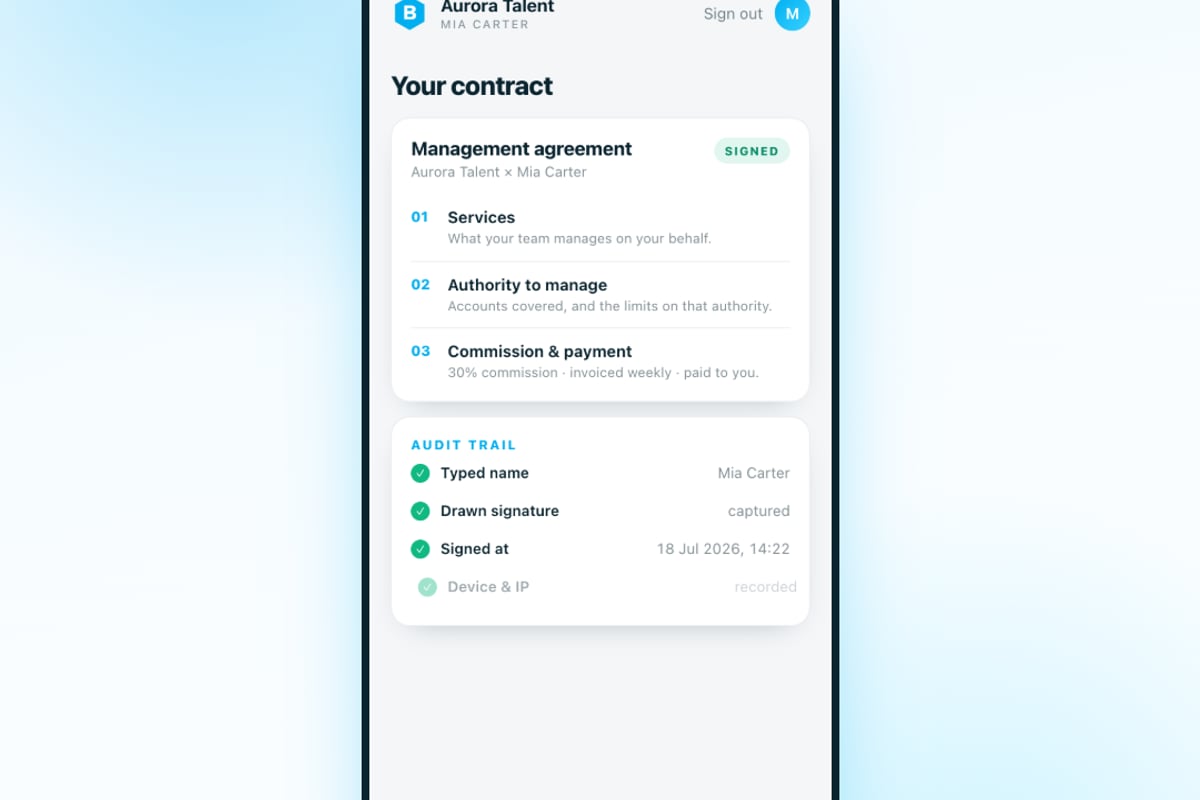
Once creators sign in contract agreements, those documents become living operational tools rather than files you archive and forget. Your executed contracts should directly inform how your systems calculate commissions, trigger payment schedules, and manage creator access to various services.
The agencies that scale efficiently integrate contract terms directly into their operating systems. When a contract specifies a forty percent commission with monthly payments, those parameters automatically configure in your financial systems. This eliminates the manual data entry that creates errors and compliance gaps.
BIGROS handles contract integration by connecting executed agreements directly to creator profiles, automatically configuring commission structures and payment schedules based on signed terms. This means your team manages talent and strategy while the system handles compliance and financial accuracy.
Building a Centralized Contract Repository
You need instant access to every executed agreement for compliance audits, dispute resolution, and operational reference. Storing contracts in email, personal cloud accounts, or local hard drives creates risk and inefficiency.
Your contract storage system must support:
- Secure access with role-based permissions limiting who sees sensitive agreements
- Version control tracking every iteration and amendment to agreements
- Search functionality finding specific creators or contract terms instantly
- Backup and redundancy preventing document loss from technical failures
- Audit trails recording who accessed or modified agreements and when
Most agencies discover they need sophisticated contract management only after experiencing a compliance audit or legal dispute. Build the system before you need it, when you're at five models rather than waiting until you're at twenty-five and scrambling.
Compliance Considerations for Creator Contracts
The legal landscape for creator agencies involves multiple overlapping compliance requirements. Your contracts must satisfy employment law considerations, tax reporting obligations, age verification mandates, and platform terms of service. Missing any of these creates liability.
When creators sign in contract agreements with your agency, you're establishing a specific legal relationship that has tax implications for both parties. Most creator relationships are structured as independent contractor arrangements rather than employment, which shifts certain compliance obligations.
Tax Documentation and Reporting
Before contract execution, collect appropriate tax documentation. For U.S.-based creators, this typically means W-9 forms. International creators require W-8 forms. These documents must be collected before any payments occur, not after the fact when you're scrambling to meet reporting deadlines.
Your contracts should explicitly state that creators are responsible for their own tax obligations and that you'll issue appropriate tax forms based on payment thresholds. This clarity prevents disputes when creators receive 1099 forms and realize they owe taxes on their earnings.
Link your contract execution workflow to your compliance management systems so that no creator can receive payments until all required documentation is on file. Automation prevents the compliance gaps that occur when teams manually track requirements across dozens of creators.
Amendments and Contract Updates
The agreements creators sign in contract at onboarding rarely remain static throughout your entire working relationship. Commission structures change, service offerings expand, and legal requirements evolve. You need clear processes for modifying existing agreements without creating enforceability problems.
Valid contract amendments require:
- Explicit agreement from both parties to the changes
- Consideration or benefit flowing to both sides
- Clear documentation of what's being modified
- Proper execution with the same formality as original agreements
- Integration with the original contract, not standalone documents
Many agencies make the mistake of sending informal amendment notices via email or chat without proper execution. These informal modifications create ambiguity about what terms actually govern the relationship.
When to Update vs. Create New Agreements
Small adjustments like commission percentage changes often work as amendments to existing contracts. Major restructuring of the relationship, such as adding equity components or fundamentally changing service scope, typically requires new agreements.
Use amendments for targeted modifications that don't alter the fundamental nature of your relationship. Execute entirely new contracts when the changes are so substantial that the original agreement no longer reflects the actual working arrangement.
Frequently Asked Questions
What happens if a creator refuses to sign the contract after verbal agreement?
If a creator won't execute formal documentation after agreeing to work with you, don't proceed with onboarding or provide any services. Verbal agreements in this industry create too much risk around commission disputes and content ownership. Either the creator signs, or you move on to prospects who will. Never start work without executed contracts.
How long should creator contracts last before renewal?
Most agencies use either one-year fixed terms or evergreen agreements with defined notice periods. Fixed terms create natural review points but require active renewal management. Evergreen agreements with thirty to sixty day notice periods provide continuity while allowing either party to exit. Choose based on your retention strategy and how often you want to renegotiate terms.
Can we modify contract terms if a creator's performance exceeds expectations?
Yes, but modifications require proper amendment execution. Many agencies build tiered commission structures directly into initial contracts that automatically adjust based on performance thresholds. This approach rewards growth without requiring constant renegotiation. When you do modify terms mid-contract, ensure amendments are properly documented and signed by both parties.
Building Standard Operating Procedures Around Contract Execution
Your sign in contract process should follow identical steps for every creator regardless of who on your team handles onboarding. Document your exact workflow in written procedures that new team members can follow without supervision.
Create step-by-step protocols covering:
- Initial agreement preparation including which template to use for different creator types
- Review and explanation procedures with specific talking points and required disclosures
- Identity verification steps that must occur before signature
- E-signature platform procedures including access, authentication, and confirmation
- Post-signature actions like file storage, system configuration, and next-step communications
Standard operating procedures eliminate the variability that creates compliance gaps when your team grows. When you're managing five models, you might remember every contract detail personally. At twenty models with multiple team members handling onboarding, you need systems that ensure consistency without your direct involvement.
Integrate your contract SOPs with your broader agency onboarding workflows so that contract execution is one step in a comprehensive process rather than an isolated event. This ensures creators move smoothly from initial interest through signed agreements to active content production.
Technology Stack for Contract Management
The tools you use to prepare, execute, and store creator contracts significantly impact your efficiency and compliance. Relying on word processors, email, and personal cloud storage creates fragmentation that becomes unmanageable as you scale.
Modern creator agencies need integrated platforms that handle the entire contract lifecycle within their broader operating systems. Look for solutions that connect contract execution to creator profiles, financial systems, and compliance tracking.
| Feature | Why It Matters | Impact on Operations |
|---|---|---|
| Template management | Ensures consistent terms and reduces preparation time | Faster onboarding, fewer legal gaps |
| E-signature integration | Enables instant execution with proper authentication | Removes delay between agreement and active status |
| Automated storage | Prevents lost documents and enables instant retrieval | Supports compliance audits and dispute resolution |
| Terms-based automation | Configures systems based on executed contract terms | Eliminates manual data entry and calculation errors |
The right technology eliminates the administrative burden of contract management while improving legal protection. When you can prepare, execute, and integrate a new creator agreement in fifteen minutes rather than several days, you can scale your onboarding capacity without adding staff.
Training Your Team on Contract Protocols
Everyone involved in creator onboarding needs to understand proper contract procedures, not just your legal or compliance specialists. The account managers, onboarding coordinators, and support staff who interact with creators must know what can and cannot be modified, what requires formal amendments, and how to answer basic contract questions.
Develop training covering:
- Key terms in your standard agreements and what they mean in practice
- Which contract elements are negotiable and which are standard for all creators
- How to explain commission structures so creators understand calculations
- Warning signs that a creator doesn't understand terms they're about to sign
- Escalation procedures for unusual situations or requests outside standard terms
Regular training prevents the gradual drift where team members start making informal commitments that aren't reflected in executed contracts. When someone tells a creator "we'll pay you within five days" but the contract specifies net-thirty terms, you've created a compliance problem and damaged trust.
The sign in contract process represents the foundation of every creator relationship your agency manages. By building systematic workflows that ensure legal validity, creator understanding, and operational integration, you transform contracts from administrative burdens into strategic assets that protect your revenue and enable confident scaling. BIGROS streamlines the entire creator lifecycle from initial inquiry through contract execution to ongoing payment management, giving you the operating system your growing agency needs to manage twenty, fifty, or a hundred creators without drowning in paperwork.