

Running a creator agency means processing dozens of invoices every month-from model payouts and platform fees to contractor payments and software subscriptions. As your roster grows beyond 15–20 models, invoice checks become the difference between healthy margins and profit leakage. A single missed duplicate payment or fraudulent invoice can cost thousands, while manual verification bottlenecks slow your entire operation. Robust invoice checks protect your cash flow, maintain compliance, and free your team to focus on talent instead of paperwork.
Why Invoice Checks Matter for OFM Agencies
Creator agencies operate on tight margins. You're splitting revenue with models, paying chatters and content managers, covering platform fees, and managing overhead. Every percentage point matters.
Invoice checks serve three critical functions in this environment. First, they verify accuracy-ensuring the amounts, dates, and recipients match your agreements and records. Second, they prevent fraud, from duplicate submissions to completely fabricated invoices. Third, they create an audit trail for tax compliance and financial reporting.
When you're managing an OnlyFans chatting team or coordinating multiple content staff, invoice volume scales faster than most founders anticipate. A model earning $50,000 monthly might generate 15–20 related invoices: her payout, chatter commissions, photographer fees, equipment purchases, and software subscriptions.

The Cost of Poor Invoice Controls
The numbers tell the story. Accounts payable departments lose an average of 1.2% of annual processing volume to invoice fraud and errors. For a creator agency processing $2 million annually, that's $24,000 walking out the door.
Common problems compound as you scale:
- Duplicate payments when the same invoice arrives via email and your agency portal
- Overpayments from percentage miscalculations or outdated commission rates
- Fraudulent vendor invoices impersonating legitimate service providers
- Timing errors that misallocate expenses across reporting periods
- Missing documentation that creates compliance gaps during audits
These issues don't just drain cash. They erode trust with models, create confusion in your profit and loss reporting, and distract leadership from revenue-generating activities.
Building a Systematic Invoice Check Process
Your invoice verification workflow needs to balance thoroughness with speed. Models expect timely payouts, vendors need to be paid on schedule, and your team shouldn't spend half their day cross-referencing spreadsheets.
Step One: Centralized Invoice Intake
Every invoice should enter your system through a single channel. Accepting invoices via email, text, direct message, and paper creates tracking chaos and opens fraud vectors.
Set up a dedicated email address ([email protected]) or, better yet, a portal where vendors and models submit invoices directly into your management system. This creates automatic timestamping, assigns tracking numbers, and ensures nothing gets lost in a personal inbox.
Define submission requirements upfront: invoice number, date, itemized services, payment terms, and any supporting documentation. Reject incomplete submissions immediately rather than chasing information later.
Step Two: Initial Data Validation
The first invoice check layer catches basic errors before human review. Automated systems excel here, flagging issues instantly:
| Validation Check | Purpose | Common Catches |
|---|---|---|
| Duplicate detection | Prevent double payment | Same invoice number, amount, or vendor combination |
| Vendor verification | Confirm legitimacy | Unrecognized vendors, mismatched bank details |
| Amount limits | Flag unusual values | Invoices exceeding contract terms or historical patterns |
| Date logic | Ensure proper period | Future-dated invoices, expired payment terms |
| Required fields | Enforce completeness | Missing tax IDs, purchase order numbers, line items |
This layer doesn't require judgment-just consistent rule application. It should automatically route flagged invoices to manual review while advancing clean submissions to the next stage.
Step Three: Contract and Agreement Cross-Reference
Here's where invoice checks get specific to creator agencies. Every payment should tie back to a signed agreement: your management contract with models, staff employment terms, or vendor service agreements.
For model payouts, verify:
- Commission split matches the signed percentage (typically 20-50% to the agency)
- Earnings period aligns with your payment cycle
- Platform fees have been correctly deducted
- Bonus structures or tiered rates apply correctly based on performance
For contractor invoices, confirm:
- Scope of work matches the approved project or retainer
- Hourly rates or project fees align with the agreement
- Hours claimed fall within reasonable ranges for the deliverables
- Expenses were pre-approved and include required receipts
This cross-reference catches the majority of accidental errors and intentional inflation before money moves. Understanding how AI is changing the fight against invoice fraud reveals how machine learning can automate much of this comparison work.
Advanced Invoice Check Techniques

Three-Way Matching Implementation
Three-way matching is the gold standard for invoice verification. You compare three documents before releasing payment:
- Purchase order or service agreement: What you agreed to buy
- Receiving confirmation: What you actually received
- Invoice: What the vendor is billing
All three must align on quantity, quality, and price. For creator agencies, "receiving confirmation" might be a model acknowledging her payout calculation, a content manager confirming delivered videos, or a software vendor providing access credentials.
This method eliminates most fraud attempts and catches honest mistakes before they become disputes. Learn more about preventing duplicate invoice fraud through systematic controls like three-way matching.
Segregation of Duties
No single person should be able to request services, approve invoices, and process payments. This basic control prevents both fraud and honest mistakes that go unchecked.
In a growing agency:
- Account managers request services and confirm delivery
- Finance or operations performs invoice checks and approval
- Founder or CFO authorizes payments above a threshold (e.g., $5,000)
Even in a lean team, you can build separation. One person verifies against contracts, another processes the payment. Digital approval workflows make this seamless without physical paper routing.
Vendor Verification Protocols
Before processing any invoice from a new vendor, complete these verification steps:
- Search the business name and tax ID in state databases
- Confirm the bank account details via phone (to a number you found, not one on the invoice)
- Request a W-9 form for US vendors or appropriate tax documentation for international providers
- Start with small test payments before processing larger invoices
Fraudsters often create convincing fake invoices from legitimate-looking companies. A quick verification call prevents costly mistakes. Explore comprehensive invoice fraud prevention strategies to protect your agency from increasingly sophisticated schemes.
Automating Invoice Checks at Scale
Manual invoice checks work fine for your first 10 models. Beyond that, you need automation or you'll drown in administrative work.
Modern creator agency operating systems centralize invoice management alongside your entire operation. When onboarding is connected to contracts, which link to revenue tracking, which feeds into automated invoicing, your invoice checks happen in the flow of work rather than as a separate administrative burden.
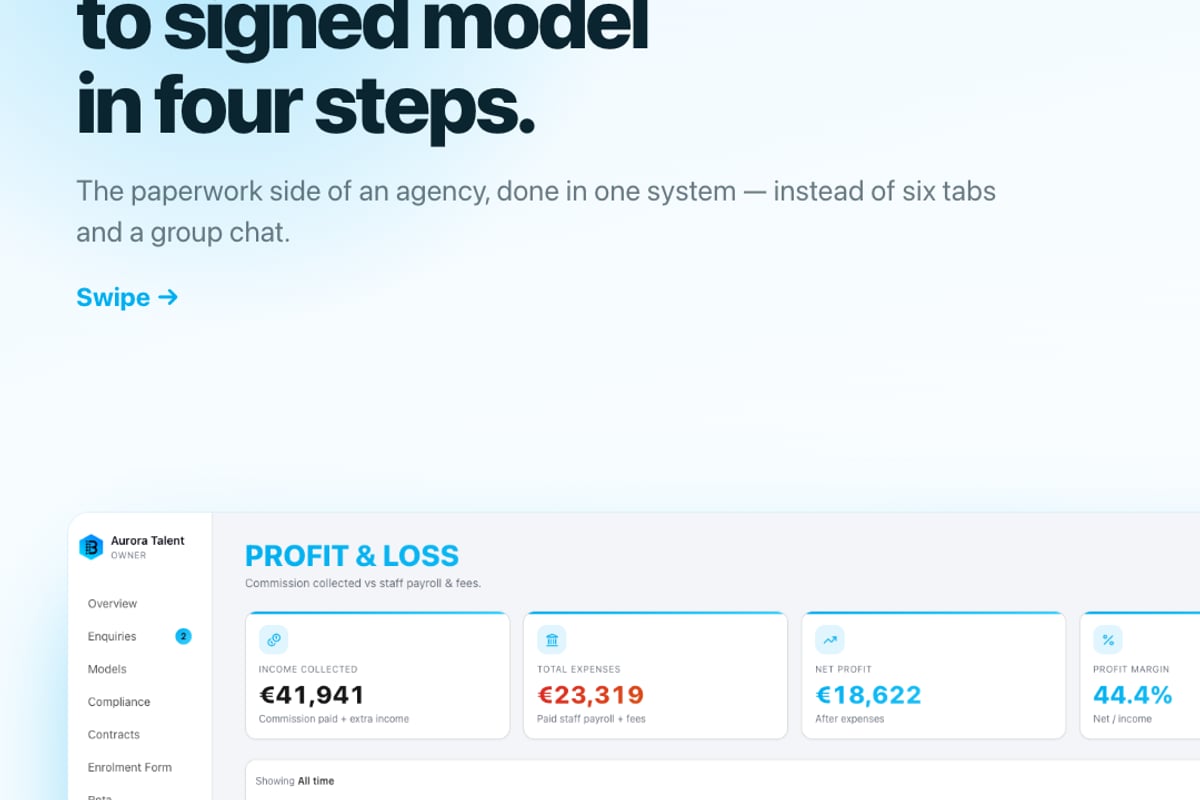
The Creator Agency Operating System built into BIGROS demonstrates this integration-invoices, compliance, and payroll all verify against each other automatically, flagging exceptions for human review.
Key Automation Features to Prioritize
Automatic commission calculations based on platform earnings eliminate the most common source of payout errors. The system pulls revenue data, applies the contracted split, deducts any agreed expenses, and generates the payout invoice-all without manual spreadsheet work.
Duplicate detection algorithms scan for matching invoice numbers, similar amounts to the same vendor within a short timeframe, and identical line items. These prevent the accidental double-payment that manual review often misses.
Approval routing sends invoices to the right person based on amount, category, or vendor. Routine model payouts auto-approve below a threshold, while new vendors or unusual amounts queue for manual review.
Audit logs track who viewed, approved, or edited each invoice. This transparency prevents disputes and provides documentation for compliance reviews.
Integration with Financial Systems
Your invoice check system should connect directly to your accounting software. Manual data entry between systems creates opportunities for errors and delays reconciliation.
Look for:
- Automatic export to QuickBooks, Xero, or your accounting platform
- Real-time sync of vendor information and payment status
- Category mapping that assigns invoices to the correct chart of accounts
- Bank feed integration that matches payments to approved invoices
This connectivity means invoice checks become part of your financial close process rather than a separate workflow. You'll spot discrepancies faster and produce accurate financial statements for tax purposes or investor reporting.
Red Flags During Invoice Checks
Train your team to recognize these warning signs during manual review:
- Rush requests pressuring immediate payment "or services will be interrupted"
- Bank account changes without prior written notice from verified contacts
- Rounded numbers that seem too convenient ($10,000.00 vs. $9,847.23)
- Poor formatting with spelling errors or inconsistent branding
- Unfamiliar vendors for routine services you thought were handled in-house
- Missing details like purchase order numbers or specific service descriptions
Any of these warrants additional verification before payment. A five-minute phone call can save thousands. Review detailed invoice fraud detection methods to sharpen your team's awareness of sophisticated fraud attempts.
Invoice Check Workflows for Different Payment Types
Model Payout Verification
Model payouts represent your largest payment category and require specialized checks:
- Pull platform earnings for the period (typically monthly or bi-weekly)
- Verify against your dashboard to confirm the platform hasn't been compromised
- Apply the commission split from the signed contract
- Deduct any agreed expenses (platform fees, equipment loans, advance repayments)
- Cross-check with previous periods for unusual fluctuations
- Obtain model confirmation of the calculated amount before processing
This verification protects both parties. Models appreciate transparency, and you prevent disputes that damage relationships. For guidance on structuring these payments, see how to pay OnlyFans creators effectively.
Staff and Contractor Payments
For chatters, content managers, and other team members:
- Time tracking integration: Hours claimed match approved timesheets
- Rate verification: Current hourly or project rates apply correctly
- Deliverable confirmation: For project-based work, confirm completion before payment
- Expense receipts: All reimbursements include original documentation
- Contract renewal dates: Flag when agreements are expiring and rates may change
Vendor and Service Invoices
Software subscriptions, equipment rentals, and professional services need different scrutiny:
- Subscription match: Recurring charges align with active services and users
- Usage-based billing: Review consumption reports for metered services
- Contract terms: Annual renewals, auto-escalation clauses, or promotional periods ending
- Cancellation verification: Ensure you're not paying for services you've discontinued
- Alternative quotes: Periodically verify competitive pricing for major expenses

Building Invoice Check SOPs for Your Team
Standard operating procedures ensure consistent invoice checks regardless of who's processing payments. Your SOP should document:
Authority levels and approval thresholds: Who can approve what amounts, which categories require additional sign-off, and escalation procedures for exceptions.
Timing and deadlines: When invoices must be submitted to meet payment cycles, how long verification takes, and when payments process.
Documentation requirements: What supporting materials each invoice type needs, where to store them, and retention periods for tax compliance.
Exception handling: How to research discrepancies, who to contact for clarification, and when to reject or delay payment.
Technology access: Which team members use which systems, password management, and backup procedures when someone is unavailable.
Share this SOP during onboarding for new staff and update it quarterly as your processes evolve. A well-documented procedure prevents knowledge silos and maintains consistency through team changes.
Compliance and Audit Considerations
Invoice checks directly impact your compliance posture and audit readiness. Tax authorities, potential acquirers, and sophisticated investors all review invoice documentation.
Tax Documentation Requirements
Every invoice should include or link to:
- Vendor tax ID (W-9, W-8BEN, or equivalent)
- Proper categorization for expense deduction
- State and local tax compliance for services rendered
- Form 1099 tracking for contractors above reporting thresholds
Missing documentation can disallow deductions or trigger penalties during audits. Build these requirements into your intake process rather than scrambling during tax season. Review your compliance checklist to ensure invoice processes align with broader regulatory requirements.
Retention and Organization
Maintain invoice records for at least seven years in both digital and backup formats. Organize by:
- Fiscal year and month for quick period-based retrieval
- Vendor name for relationship review and contract negotiation
- Category for expense analysis and budget planning
- Payment status to track outstanding obligations
Cloud storage with redundant backup prevents loss from hardware failure or disasters. Ensure your storage solution includes version history to track any invoice modifications.
Common Invoice Check Mistakes to Avoid
Even experienced agencies fall into these traps:
Approval fatigue: When someone sees hundreds of invoices weekly, they start rubber-stamping. Rotate approval duties or require periodic spot-checks to maintain vigilance.
Trust-based processing: "Sarah has worked with us for two years, we don't need to verify her invoices." Trust, but verify-always. Fraud often comes from long-term relationships where controls have relaxed.
Disconnected systems: Managing invoices in one system, contracts in another, and payments in a third creates reconciliation nightmares. Integration saves time and reduces errors.
Reactive rather than preventive: Only implementing invoice checks after discovering fraud or errors. Build controls from day one; they're harder to retrofit later.
Incomplete vendor files: Accepting invoices from vendors without complete documentation on file. Require W-9s, contracts, and insurance certificates upfront.
For deeper insights into detection strategies, explore practical guides to invoice fraud detection that outline both manual and automated approaches.
FAQ: Invoice Checks for Creator Agencies
How often should we perform invoice checks for recurring model payouts?
Verify every payment, even for models you've worked with for years. Automated systems make this effortless-they confirm earnings, apply the correct split, and flag anomalies without manual work. For models with consistent earnings patterns, spot-check the calculations monthly and perform deep verification quarterly.
What's the biggest invoice fraud risk for OFM agencies?
Business email compromise ranks highest. Fraudsters impersonate models or vendors via email, requesting payment to altered bank accounts. Always verify bank account changes through a phone call to a number you have on file, never one provided in the change request email. Implement multi-factor authentication and train staff to recognize phishing attempts.
Should small agencies with under 10 models invest in automated invoice systems?
Yes, even at small scale. The time saved on manual spreadsheet work pays for basic automation within weeks. More importantly, you establish proper controls before scaling. Retrofitting processes after you've grown to 20–30 models creates disruption and risk. Start with good habits, then scale them. Understanding commission rate structures helps you configure automated calculations correctly from the start.
How do we handle invoice disputes with models or vendors?
Document everything. Maintain clear records of the original contract terms, calculation methodology, and communications. Most disputes arise from miscommunication rather than intentional disagreement. Walk through the invoice check process together, showing how you arrived at the amount. If genuine errors occurred, correct them immediately and adjust your processes to prevent recurrence. For persistent disagreements, your contract should specify dispute resolution procedures.
What threshold should trigger additional approval for invoices?
This depends on your volume and risk tolerance. Many agencies use $5,000 as a secondary approval threshold, with anything above $25,000 requiring founder sign-off. More important than the specific number is segregation of duties-ensuring the person who requested the service doesn't also approve the invoice. Adjust thresholds as you grow; a $5,000 invoice represents different risk at $100K monthly revenue versus $1M.
Effective invoice checks protect your margins, prevent fraud, and create the financial clarity you need to make smart growth decisions. As your roster expands and payment volume increases, systematic verification becomes essential infrastructure rather than administrative overhead. BIGROS handles invoice checks alongside compliance, onboarding, and payroll in a single operating system purpose-built for creator agencies, letting you focus on talent development while the platform manages the paperwork.