
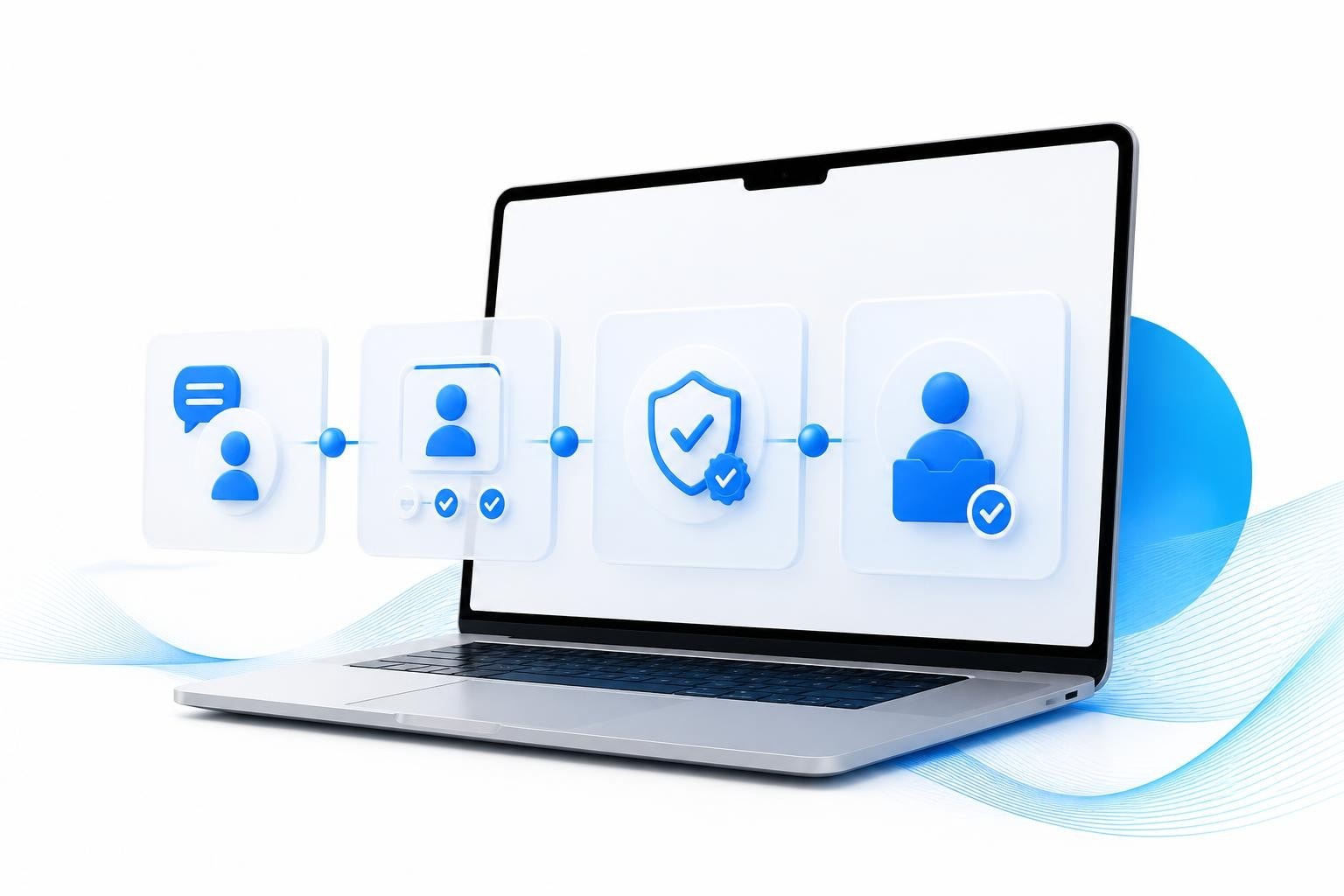
A functional leads system determines whether your creator agency plateaus at ten models or scales past fifty. Most agencies start with direct messages, spreadsheets, and good intentions, then wonder why they lose track of promising talent or onboard models who disappear after two weeks. The difference between struggling agencies and those building predictable monthly revenue lies in how systematically they capture, qualify, and convert inquiries into revenue-generating creators.
Why Creator Agencies Need Purpose-Built Lead Systems
Traditional CRM platforms assume you're selling software licenses or consulting hours. Creator agencies operate differently. Your "leads" are models who need vetting, compliance documentation, contract negotiation, and onboarding before they generate a single dollar. A spreadsheet might track twenty conversations, but it won't flag missing ID verification, remind your team about follow-up calls, or calculate projected revenue based on historical conversion rates.
Your leads system needs to handle three distinct functions: capturing every inquiry regardless of source, filtering out time-wasters before they consume staff hours, and moving qualified candidates through a structured pipeline. When these functions work together, your acquisition cost drops and onboarding speed increases.
The Cost of Manual Lead Tracking
Running inquiries through Instagram DMs and Google Sheets creates predictable problems at scale. Messages get buried, team members duplicate outreach, and no one knows which recruiter spoke to which model last Tuesday. You'll lose high-potential talent simply because someone forgot to follow up.
Industry research shows that effective lead management best practices can dramatically improve conversion rates across sales organizations. The same principles apply when your "sale" is convincing a model to sign a management contract.

Building Your Agency's Lead Capture Framework
Start by identifying every channel where models find you. Applications come through landing pages, Instagram profiles, referrals from existing models, Twitter DMs, and sometimes cold outreach from your team. Each source needs a clear entry point into your system.
Create a single intake form that captures the information you need for initial qualification:
- Current platform username (OnlyFans, Fansly, etc.)
- Current monthly earnings range
- Content creation experience (duration and consistency)
- Management experience (current or previous agency)
- Preferred contact method and timezone
- Social media presence and follower counts
This isn't about interrogating applicants; it's about having enough data to make smart decisions quickly. You need to know if someone is earning two hundred dollars monthly or twenty thousand before you invest hours in calls and paperwork.
Route all inquiries through this form, even referrals. When existing models recommend friends, ask them to complete the same intake. This creates consistency and prevents the "friend of a friend" exception that bypasses your qualification process.
Scoring and Segmentation Logic
Not every inquiry deserves the same response time. Build a scoring system based on the variables that predict success in your portfolio. Models earning above five thousand monthly with verified earnings, consistent posting history, and no current management typically warrant immediate outreach. Complete beginners or those with problematic social media footprints might receive a template response directing them to educational resources.
| Lead Score | Criteria | Response Time | Assigned To |
|---|---|---|---|
| Hot (80-100) | $5k+ verified, no mgmt, clean socials | 2 hours | Senior recruiter |
| Warm (50-79) | $1k-5k verified, limited mgmt history | 24 hours | Junior recruiter |
| Cold (20-49) | Under $1k, beginner, needs education | 72 hours | Automated sequence |
| Disqualified | Underage, policy violations, fake earnings | Immediate | Auto-reject template |
This scoring happens automatically when inquiries enter your system. The alternative is every recruiter making subjective calls about who matters, leading to inconsistent standards and missed opportunities.
Qualification and Pipeline Management
Once leads enter your system, they need to move through defined stages. Each stage represents a specific milestone that indicates increasing commitment and fit. Understanding how lead management integrates with CRM systems helps clarify why structured pipelines outperform ad-hoc approaches.
Your pipeline might include these stages:
- New Inquiry – Form submitted, not yet contacted
- Initial Contact – First conversation completed, interest confirmed
- Portfolio Review – Earnings verified, content quality assessed
- Compliance Submitted – ID, tax docs, and required forms received
- Contract Sent – Terms negotiated, agreement sent for signature
- Onboarding Scheduled – Contract signed, kickoff call booked
- Active Model – Fully onboarded and producing content
Each stage has clear entry and exit criteria. A model doesn't move to "Compliance Submitted" until your team physically has their documentation in hand. This prevents the confusion of "I think she sent her ID last week" conversations.
Track stage conversion rates and time-in-stage metrics. If fifty percent of models stall at "Compliance Submitted," you have a documentation problem, not a talent problem. If the average time from "Contract Sent" to "Onboarding Scheduled" exceeds seven days, your contract terms likely need revision or your follow-up process needs tightening.
Handling Compliance Within Your System
Compliance documentation separates professional agencies from fly-by-night operations, as detailed in guidance on OnlyFans agency compliance software. Your leads system must track which documents you've received, which are pending, and which have been verified by your compliance officer.
Create a checklist for every model:
- Government-issued photo ID (front and back)
- Proof of age verification
- Tax documentation (W-9 or international equivalent)
- Banking information for payouts
- Signed management agreement
- Content rights and exclusivity terms
- Platform terms of service acknowledgment
Until all items show green checkmarks, that lead stays in the compliance stage. No exceptions, no "we'll get it later" promises. This rigidity protects your agency legally and ensures no one starts generating revenue without proper documentation.
Managing this complexity manually becomes unworkable past fifteen models. The Creator Agency Operating System centralizes compliance tracking alongside your entire pipeline, so your team sees exactly which models need documentation and which are ready to start earning.

Communication Sequences and Follow-Up Automation
The best leads system in the world fails if your team doesn't follow up consistently. Most creator agencies lose deals not because models chose competitors, but because no one reached out at the right moment with the right message.
Build templated sequences for common scenarios:
New inquiry auto-response: "Thanks for applying. We review applications within 24 hours. Here's what happens next..."
Compliance reminder (3 days after request): "We're excited to move forward. We still need your ID and tax docs. Here's how to submit them securely..."
Contract follow-up (2 days after sending): "Have you had a chance to review our terms? I'm available Tuesday and Thursday for a quick call to answer questions..."
Re-engagement (for stalled leads): "We haven't heard from you in two weeks. Are you still interested in management? Reply YES to continue or NO to remove you from our pipeline..."
These aren't robotic spam messages. They're professional communications that respect the model's time while keeping your opportunity alive. Customize them with the model's name, specific earnings data, and relevant details from previous conversations.
When to Disqualify and Archive
Not every inquiry converts, and that's acceptable. What's not acceptable is leaving dead leads in your active pipeline, inflating your numbers and wasting recruiter time. Avoiding common lead management pitfalls means knowing when to mark someone as disqualified and move on.
Set clear disqualification triggers:
- No response after three follow-up attempts over 14 days
- Fails age or identity verification
- Unrealistic earnings expectations (wants 80% commission split)
- Currently locked into competitor contract for 12+ months
- Demonstrates unreliability (misses scheduled calls repeatedly)
Archive these leads instead of deleting them. Markets change, circumstances shift, and someone who wasn't ready in March might be perfect in September. Keep records but remove them from active workflows.
Measuring System Performance
Your leads system generates data that should inform every strategic decision. Track these metrics monthly:
| Metric | Calculation | Target Range |
|---|---|---|
| Inquiry volume | Total new leads per month | 50-100 (mature agency) |
| Qualification rate | Qualified leads / Total inquiries | 30-50% |
| Compliance completion | Docs received / Qualified leads | 60-75% |
| Contract signature rate | Signed / Sent | 40-60% |
| Onboarding completion | Active models / Signed contracts | 70-85% |
| Time to revenue | Days from inquiry to first payout | 14-21 days |
These numbers tell stories. If inquiry volume drops, your marketing needs attention. If qualification rates plummet, you're attracting the wrong audience or your intake form needs revision. If compliance completion lags, your documentation process is too complicated.
Calculate acquisition cost per model: Add up all marketing spend, recruiter salaries, and system costs, then divide by models onboarded. If you're spending three thousand dollars to acquire a model who generates five hundred monthly in agency revenue, your economics don't work. Successful agencies typically target acquisition costs below two months of projected commission revenue.
Attribution and Source Analysis
Not all lead sources produce equal results. Track which channels deliver the highest-earning, longest-tenured models. You might discover that Instagram inquiries convert at twenty percent but Twitter referrals convert at sixty percent and generate twice the revenue.
This insight lets you reallocate resources. Stop spending hours on low-performing channels and double down on what works. Some agencies find their best models come from existing model referrals, making a formal referral bonus program their highest-ROI investment.
Integrating Leads with Broader Agency Operations
Your leads system shouldn't exist in isolation. Once a model signs and onboards, their data needs to flow into other operational systems: content planning, compliance tracking, invoicing, payroll, and performance analytics. Managing these systems separately creates data silos and administrative chaos, which is why experienced agencies look for integrated management software solutions.
When onboarding new models, information captured during the lead process should automatically populate onboarding checklists, contract templates, and payment profiles. Your team shouldn't re-enter the same data across four different spreadsheets.
This integration becomes critical when you scale past twenty models. Manual data transfer between systems introduces errors, delays, and frustration. A model's preferred payment method gets entered incorrectly, their content plan references the wrong niche, or their tax documentation gets associated with someone else's file.

Team Workflows and Role Assignment
Your leads system needs to support how your team actually works. Different staff members handle different pipeline stages. Junior recruiters might handle initial outreach and qualification, while senior staff negotiate contracts and conduct onboarding calls. Your system should route leads to the right person at the right time.
Implement these workflow rules:
- New hot leads (score 80+) assign to senior recruiter immediately
- Warm leads (50-79) rotate among junior recruiting team
- Compliance stage leads assign to compliance officer for document review
- Contract negotiation leads escalate to agency principal for terms discussion
- Stalled leads (no activity for 7 days) trigger manager notification
This prevents leads from falling through cracks because everyone assumed someone else was handling them. When you're running a creator agency at scale, clarity about ownership at each stage eliminates the "I thought you were calling her" conversations.
Notification and Alert Systems
Your team can't watch the pipeline constantly. Build alerts that notify the right person when action is needed:
- Hot lead entered (instant notification to senior recruiter)
- Compliance documents uploaded (notify compliance officer)
- Contract signed (notify onboarding coordinator)
- Lead inactive for 5 days (remind assigned recruiter)
- High-value model inquiry (notify agency principal)
These alerts keep deals moving without requiring constant manual pipeline reviews. Your recruiters focus on conversations instead of checking spreadsheets every hour.
Scaling Your System as You Grow
A leads system that works for ten inquiries monthly breaks at fifty and collapses at two hundred. Plan for scale from the beginning by building modular processes that expand without complete redesign.
Start by documenting your current process in painful detail. Write down every step from "model submits form" to "model generates first month of revenue." Identify bottlenecks where one person's availability limits throughput. These bottlenecks become your first automation or delegation targets.
As volume increases, you'll need to:
- Add recruiting staff (typically one full-time recruiter per 30-40 active models)
- Implement automated qualification scoring to filter inquiries faster
- Create specialized roles (compliance officer, onboarding coordinator, retention manager)
- Develop playbooks so new team members can execute consistently
- Build training programs that maintain quality as you hire
Many agencies make the mistake of adding models without adding systems, then wonder why operations feel chaotic. Real-world examples, like how agencies automate lead management, demonstrate the value of investing in infrastructure before scaling volume.
Common System Implementation Mistakes
Agencies building their first proper leads system make predictable errors. Avoid these traps:
Over-complicating stages: Your pipeline doesn't need twelve stages. Six to eight is usually optimal. More stages create more chances for confusion and stalling.
Under-defining stage criteria: "In negotiation" means nothing if different recruiters interpret it differently. Write explicit entry and exit requirements for every stage.
Ignoring data quality: Letting team members enter "555-555-5555" as a phone number or skip required fields destroys your system's value. Enforce data standards from day one.
Setting unrealistic follow-up expectations: Requiring recruiters to contact every lead within one hour sounds ambitious but creates stress and burnout. Set achievable standards based on lead priority.
Failing to train staff: Installing software without training your team on workflows and best practices wastes money and frustrates everyone. Allocate proper time for onboarding and ongoing education.
According to research on lead management system best practices, consistent processes and team training determine success more than technology choices.
Frequently Asked Questions
How many leads should we expect to convert into signed models?
Industry benchmarks vary, but most established creator agencies convert 25-40% of qualified leads into signed contracts, with 70-80% of signed contracts becoming active revenue-generating models. Your total inquiry-to-active-model rate typically lands between 15-30%. Track your numbers monthly to establish your baseline, then optimize from there.
What's the ideal time from inquiry to first revenue?
Target 14-21 days for high-quality leads who already have established accounts. Complete beginners might take 30-45 days while they set up accounts and create initial content. Anything longer suggests bottlenecks in your compliance, onboarding, or content planning processes that need addressing.
Should we use general CRM software or purpose-built agency tools?
General CRMs like HubSpot or Salesforce require extensive customization to handle creator agency workflows, compliance tracking, and model-specific data fields. Most agencies outgrow spreadsheets around 15 models and generic CRMs around 30 models. Purpose-built platforms designed for creator agencies eliminate customization work and include industry-specific features out of the box, as explained in comparisons of agency spreadsheets versus specialized software.
How do we handle models who ghost during onboarding?
Build a re-engagement sequence that triggers after 3-5 days of inactivity. Send a friendly check-in, offer to answer questions, and set a clear deadline: "If we don't hear from you by Friday, we'll assume you've decided to pursue other options." This respects their time while keeping your pipeline clean. About 20-30% of ghosted leads will re-engage with the right message.
What's the ROI timeline for implementing a proper leads system?
Most agencies see measurable improvements within 60-90 days: fewer lost leads, faster response times, and higher conversion rates. The financial return depends on your current conversion rate and average model value. If you're currently converting 20% of leads and a better system moves that to 30%, you've increased model acquisition by 50% with the same marketing spend. Calculate your current cost-per-acquisition and model lifetime value to project specific ROI for your situation.
A robust leads system transforms creator agency operations from reactive chaos to predictable growth. By systematically capturing inquiries, qualifying candidates, managing compliance, and tracking pipeline metrics, you'll convert more models while reducing the administrative burden on your team. BIGROS brings all these workflows into a single operating system built specifically for creator agencies, letting you manage leads, compliance, onboarding, and ongoing operations without juggling multiple platforms or drowning in spreadsheets.