

Running a creator agency means juggling dozens of moving parts simultaneously-new lead inquiries arrive while you're verifying compliance documents, models need content guidance as payroll deadlines approach, and staff members require real-time updates on fan requests. Without a structured agency system to coordinate these workflows, even experienced operators find themselves buried in spreadsheets, missing critical deadlines, and losing visibility on their actual profitability. The difference between agencies stuck at 10 models and those scaling to 50+ often comes down to having the right operational infrastructure in place.
What Makes an Effective Agency System
An agency system serves as the central nervous system for your creator business, connecting every operational function from first contact through ongoing model management. Unlike generic CRMs or project management tools, a purpose-built system recognizes the unique workflows of creator agencies-the compliance requirements, the commission structures, the content planning cycles, and the need for real-time financial visibility.
Core Components Every Agency System Needs
The foundation of any robust system starts with lead management. You need clear visibility on where prospects enter your funnel, which staff member owns each conversation, and what stage each model sits in before signing. A proper leads system prevents duplicated outreach, tracks conversion rates, and helps you identify which acquisition channels deliver the best-performing models.
Onboarding and compliance represent your most legally sensitive workflows. Your agency system must capture identification documents, verify ages, collect signatures on management contracts, and store everything in an organized, auditable format. The days of scattered Google Drive folders are over-regulators and payment processors expect professional documentation standards. Many agencies find that implementing a dedicated compliance portal reduces onboarding time from weeks to days while eliminating compliance gaps.

Content planning and coordination keeps models productive and chatters informed. Your system should show what content each model has scheduled, what niches they're targeting, and what promotional campaigns are running. This visibility prevents content gaps and ensures your whole team aligns on strategy.
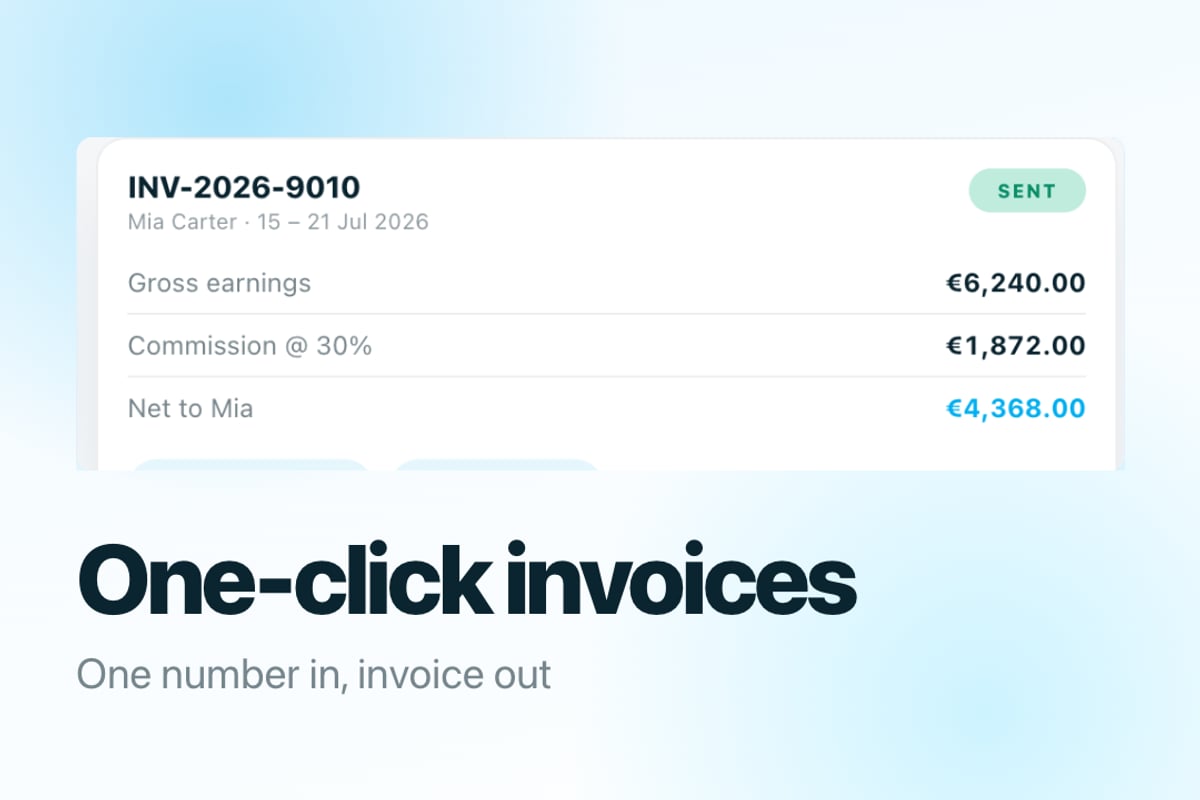
Financial operations include invoicing, commission tracking, and payroll. Without automation, calculating splits across 20+ models consumes hours every week. A proper system pulls revenue data, applies your commission structure, deducts expenses, and shows you live profit margins per model and across your entire roster.
The Operating System Approach
Traditional agencies often cobble together multiple tools-one for CRM, another for signatures, a third for invoicing, and spreadsheets for everything else. This fragmented approach creates data silos, requires constant manual transfers between systems, and makes it nearly impossible to see your business holistically.
The agency business model thrives on coordination and visibility. An operating system approach consolidates every function into a unified platform where data flows automatically between modules. When a model signs their contract, that action triggers compliance checks, creates their payment profile, notifies relevant staff, and updates your roster dashboard-all without manual intervention.
Building Your Agency System Infrastructure
Setting up a functional agency system requires methodical planning. Many operators rush into software purchases without mapping their actual workflows, leading to expensive tools that don't match their processes.
Step One: Map Your Current Workflows
Start by documenting how work actually flows through your agency today. Track a single model from initial contact through their third payout. Note every handoff, every document exchange, every approval gate, and every data entry point. This audit reveals your bottlenecks and redundancies before you invest in solutions.
Common workflow stages include:
- Initial inquiry capture and response
- Discovery call scheduling and completion
- Contract negotiation and signing
- ID and age verification
- Profile setup and content planning
- First content creation and posting
- Revenue tracking and commission calculation
- Regular payouts and tax documentation
Step Two: Identify Integration Points
Your agency system needs to connect with external platforms where your models earn revenue. For OFM agencies, this typically means pulling earnings data, tracking subscriber counts, and monitoring content performance. The right system handles these integrations automatically, eliminating manual data entry and reducing errors.
Consider which tools your team already uses effectively. Forcing staff to abandon functional tools creates resistance. Instead, look for systems that integrate with existing workflows rather than requiring complete process overhauls.
Step Three: Prioritize Automation Opportunities
Not every task deserves automation, but repetitive, rules-based processes should move to the top of your list. Calculate how many hours your team spends each week on tasks like:
| Task | Manual Hours/Week | Automation Potential |
|---|---|---|
| Entering lead data | 3-5 hours | High |
| Chasing contract signatures | 2-4 hours | High |
| Calculating commission splits | 4-6 hours | Very High |
| Sending payout notifications | 1-2 hours | High |
| Updating model dashboards | 2-3 hours | Very High |
| Generating P&L reports | 3-4 hours | Very High |
Even modest automation saves 15-20 hours weekly on a 20-model roster. As you scale, these savings multiply exponentially.

Critical Features for Creator Agency Operations
When evaluating agency system options, certain features separate professional platforms from generic business tools. Understanding the key components of an effective agency model helps you assess whether a system truly fits creator agency needs.
Real-Time Financial Dashboards
You cannot manage what you cannot measure. Your system should display current month revenue, projected payouts, pending invoices, and profit margins without requiring manual report generation. Live P&L visibility lets you make informed decisions about hiring, model acquisition, and resource allocation.
The best systems break down profitability per model, letting you identify top performers and models who may need additional support or restructured agreements. This granularity proves essential when determining appropriate commission rates and evaluating agency profitability.
Staff Permission and Role Management
As your team grows beyond the founding operator, you need granular control over who sees what information. Chatters should access model content plans and messaging guidelines without viewing financial data. Accountants need payout information but not lead pipeline details. Recruiters require lead management tools without full model roster access.
Role-based permissions protect sensitive information while ensuring each team member has the tools they need. This becomes critical as you manage your chatting team effectively and scale operations.
Notification and Task Management
Creator agencies operate around fan requests, content deadlines, and time-sensitive compliance requirements. A robust notification system ensures nothing falls through the cracks:
- New model inquiries alert the assigned recruiter immediately
- Contract signatures trigger compliance team reviews
- Upcoming payout dates notify accounting staff
- Content approval requests reach managers in real-time
- Missing compliance documents generate automatic reminders
Document Storage and Retrieval
Every model's folder should contain their contract, ID verification, tax forms, content guidelines, and communication history. When a payment processor requests documentation or a regulatory question arises, you need instant retrieval-not a 30-minute search through scattered files.
Cloud-based storage with robust search, tagging, and version control protects your agency legally and operationally. The compliance considerations outlined in legal resources emphasize documentation as a core risk management strategy.
Scaling Your Agency System Past 15-20 Models
Most agencies hit their first major scaling wall around 15-20 models. The informal processes that worked with a handful of creators break down under increased volume. Communication becomes chaotic, financial tracking grows unreliable, and staff members waste time hunting for information.
Standardizing Onboarding Processes
Inconsistent onboarding creates downstream problems for months. Some models receive comprehensive content strategy, while others get minimal guidance. Compliance documentation varies in completeness. Contract terms differ based on who negotiated them.
Your agency system should enforce standardized model onboarding steps that every new creator completes:
- Complete initial application with all required fields
- Submit government-issued ID for age verification
- Review and sign standard management contract
- Complete tax documentation and payment setup
- Attend onboarding call with assigned manager
- Receive content strategy and posting schedule
- Get access to content planning tools and team communication
This consistency ensures every model starts with the same foundation, regardless of which team member handles their onboarding.
Creating Content Planning Systems
Ad-hoc content management doesn't scale. Your system needs structured content plans that outline posting schedules, content themes, and promotional campaigns. Models should see their weekly targets, chatters should understand messaging angles, and managers should monitor completion rates.
Content planning visibility prevents the most common scaling problem: models feeling neglected as your roster grows. When everyone can see the plan and track progress, models receive consistent attention even as your agency expands.
Implementing Financial Controls
Financial errors compound quickly. A miscalculated commission on one model's payout might cost you $200-across 30 models, that same error becomes a $6,000 problem. Your system must automate commission calculations, apply them consistently, and flag anomalies for review.
Consider implementing approval workflows for payouts exceeding certain thresholds, requiring manager sign-off before processing. This adds a safety check without slowing down routine operations.
Common Agency System Implementation Mistakes
Even experienced operators make predictable mistakes when implementing new systems. Avoiding these pitfalls accelerates your timeline and prevents costly errors.
Mistake One: Incomplete Data Migration
Rushing implementation without properly migrating existing data creates a divided system. Half your models live in the new platform while others remain in spreadsheets. This fragmentation defeats the purpose of consolidation.
Budget adequate time for data cleanup and migration. Verify that historical contracts, payment records, and model information transfer accurately before fully committing to the new system.
Mistake Two: Inadequate Staff Training
Your system only works if your team actually uses it. Providing one training session and expecting perfect adoption sets everyone up for failure. Plan for ongoing training, create documentation, and designate system champions who can answer questions and reinforce best practices.
When starting or scaling an agency, remember that technology adoption is a people challenge as much as a technical one.
Mistake Three: Over-Customization Too Early
Many platforms offer extensive customization options. Resist the urge to tweak every setting immediately. Start with standard configurations, let your team develop familiarity, then customize based on actual usage patterns rather than theoretical preferences.
Excessive early customization often creates complexity that confuses users and makes future updates more difficult.
Choosing the Right Agency System for Your Operation
The landscape of agency operating systems has evolved significantly in recent years, with platforms emerging specifically for creator agency needs. Generic CRMs and project management tools cannot match the specialized workflows these purpose-built systems provide.
Evaluation Criteria
When comparing options, assess each platform against these critical factors:
Industry specificity: Does the system understand creator agency workflows, or are you adapting a generic business tool? Purpose-built platforms include features like age verification, content planning, and commission automation that generic tools lack.
All-in-one vs. best-of-breed: Consolidated platforms reduce integration headaches but may lack depth in certain areas. Best-of-breed approaches offer superior individual tools but require you to manage connections between them. For most agencies scaling past 15 models, the coordination benefits of an all-in-one system outweigh the trade-offs.
Pricing structure: Understand whether you pay per user, per model, or a flat monthly fee. As you scale, per-model pricing can become prohibitively expensive, while per-user pricing may limit team growth. Evaluate costs at your current size and projected 12-month size.
Support and updates: Creator platforms and regulations evolve constantly. Your system provider should ship regular updates, respond to compliance changes quickly, and offer reliable support when issues arise.
BIGROS was built specifically for OFM creator agencies, emerging from operational experience at BIGR Agency. The platform consolidates lead management, onboarding, compliance, financial tracking, and team coordination into a unified operating system designed for the unique demands of creator agency operations.
Migration Planning
Switching systems mid-operation requires careful planning. Ideally, time your migration for a slower period when you're not actively onboarding multiple models. Create a parallel operation period where you run both old and new systems simultaneously, validating that the new platform handles all critical workflows before fully cutting over.
Communicate the transition timeline to your team and your models. Set expectations that the first few weeks may involve learning curves and minor inefficiencies as everyone adapts.
FAQ About Agency Systems
How long does it take to fully implement a new agency system?
Implementation timelines vary based on roster size and system complexity. Most agencies achieve basic functionality within 1-2 weeks but require 4-6 weeks for full team adoption and workflow optimization. Plan for a transition period rather than expecting immediate perfection.
Can an agency system integrate with existing accounting software?
Quality agency systems offer export capabilities for financial data, allowing integration with popular accounting platforms like QuickBooks or Xero. Some provide direct integrations, while others use CSV exports that accounting software can import. Verify integration options before committing to ensure compatibility with your existing financial infrastructure.
What happens to data if I need to switch systems later?
Reputable platforms provide data export functionality, allowing you to retrieve model information, contract documents, and financial records. Before signing contracts, confirm the provider's data portability policies and export formats. Avoid platforms that lock your data without reasonable export options.
How much technical expertise do I need to manage an agency system?
Modern agency systems prioritize user-friendly interfaces that don't require technical backgrounds. If you can navigate standard business software, you can manage most agency platforms. Look for systems with intuitive dashboards, clear documentation, and responsive support teams rather than those requiring extensive technical configuration.
Should I build a custom system or use an existing platform?
Custom development rarely makes sense for agencies under 100 models. The time and cost to build, test, and maintain custom software far exceeds subscription costs for proven platforms. Existing systems benefit from continuous updates, security patches, and feature development that custom solutions struggle to match. Focus your resources on growing your agency rather than building infrastructure unless you have very specific requirements no existing platform addresses.
The Competitive Advantage of Operational Excellence
As the creator agency market matures, operational sophistication increasingly separates successful agencies from struggling competitors. The various agency business models available in 2026 all face similar scaling challenges-the winners invest in systems that enable efficient growth.
Models notice the difference between agencies running on spreadsheets versus professional platforms. Faster onboarding, clearer communication, reliable payouts, and organized content planning create better creator experiences. In a competitive recruitment environment, operational excellence becomes your differentiator.
Your agency system isn't just internal infrastructure-it directly impacts model satisfaction and retention. When creators see professional operations, they trust you with their careers and recommend you to other models. This compounds over time, turning operational investment into sustainable competitive advantage.
Scaling a creator agency beyond 15-20 models demands more than hustle and industry connections-it requires operational infrastructure that coordinates complex workflows, ensures compliance, and provides financial visibility. A purpose-built agency system transforms scattered processes into a coordinated operation where your team focuses on model success rather than administrative chaos. BIGROS delivers exactly this: a unified operating system for OFM agencies that handles everything from lead intake through live P&L tracking, built by operators who understand your daily challenges.